History of Cetviny/Zettwing
| 13. st. – 1611 | Cetviny/Zettwing owned by the Rožmberk / Rosenberg family |
| 1611 – 1918 | Cetviny/Zettwing owned by the Buquoy family |
| 1918 – 1938 | Cetviny/Zettwing during the First (Czechoslovak) Republic |
| 1938 – 1951 | Cetviny/Zettwing during the war and post-war years |
| 1951 – 1990 | Cetviny/Zettwing behind the Iron Curtain |
| 1990 - dnes | Cetviny/Zettwing after the fall of the Iron Curtain |
Cetviny/Zettwing owned by the Rožmberk (Rosenberg) family
| 13th century | The village was probably founded by colonists from Austria. The origin of the name Cetviny/Zettwing, sometimes also Cetvina, is not precisely documented. According to some hypotheses, it is a name of a settlement derived from the name Cetva or Četa. According to others, it is derived from the name Zettwein. There are also hypotheses about its Celtic origin. |
| 1325 | First written mention of the village of Cetviny/Zettwing. In a document dated December 21, 1325, Petr of Rožmberk pledged the villages of Cetviny/Zettwing and Mikulov ("die Dörfer Zetbunne und Nicolts") to Bohuňka of Harrach for 83 silver coins. |
| 1374 | First written mention of the Church of the Virgin Mary. |
| 1418 | Cetviny/Zettwing is mentioned as a market town. Oldřich of Rožmberk (Ulrich von Rosenberg) grants the first privileges. |
| 1420-23 | Records of chiliasts and Hussites passing through the region and causing damage. However, Cetviny/Zettwing was apparently not affected. |
| 1498 | Petr of Rožmberk (Peter von Rosenberg) confirms and extends the privileges granted in 1418. At the same time, he grants the town the Rožmberk seal and coat of arms. Cetviny/Zettwing receives a red five-petal rose with a gold center on a silver shield as its coat of arms. |
| 1541 | First mention of the school in Cetviny/Zettwing. |
| 1563 | Vilém of Rožmberk (Wilhelm von Rosenberg) grants the citizens of Cetviny/Zettwing the right to brew beer. |
| 1593 | The Rožmberks (Rosenbergs) establish a mill (Herrenmühle) in Cetviny/Zettwing. |
| 1611 | After the death of Petr Vok, the Rožmberk (Rosenberg) family dies out in the male line and the Švamberk (Schwanberg) family takes over the regency of Cetviny/Zettwing. |
Cetviny/Zettwing owned by the Buquoy family
| 1619 | In the second year of the Thirty Years' War, Cetviny/Zettwing is plundered and burned by the soldiers of General Heinrich von Dampierre. The town is left in ruins and the local population flees to the surrounding forests. |
| 1620 | Cetviny/Zettwing passed into the ownership of the Buquoy family. The estates of the Protestant Švamberk (Schwanberg) family fell to Emperor Ferdinand II after the defeat of the Czech estates. He transferred the Rožmberk and Novohrad estates to Karel (Karl) Bonaventura Buquoy. |
| 1623-28 | At the instigation of Countess Maria Magdalena Buquoy, a counter-reformation takes place on the new Buquoy estates, including Cetviny/Zettwing. All Protestants are forced to convert to Catholicism. |
| 1760-65 | Jan (Johann) Buquoy founded the settlement of Janova ves (Johannesdorf) near Cetviny/Zettwing. |
| 1772 | A plague column dedicated to St. John of Nepomuk is erected in the square in Cetviny/Zettwing. |
| 1792 | A new cemetery is established. |
| 1795 | Cetviny/Zettwing, including the church, destroyed by a fire caused by the carelessness of one of the town's residents. |
| 1805-6 | Retreating French soldiers from Napoleon's army looted Cetviny/Zettwing. |
| 1827 | Construction of a parish chapel (Pfarrkapelle) in the parish forest above Cetviny/Zettwing. |
| 1849 | Abolition of the manorial system; Cetviny/Zettwing becomes an independent political municipality. |
| 1866 | The inhabitants of Cetvin hide their livestock and valuables in the forests from the passing Prussian troops. |
| 1883 | Construction of the Way of the Cross at the parish chapel. |
| 1892 | Construction of a cave chapel (Grottenkapelle) in the parish forest. |
| 1909 | Establishment of a post office in Cetviny/Zettwing. |
| 1914-18 | Eighteen men from Cetviny/Zettwing fell in World War I. |
Cetviny/Zettwing during the First (Czechoslovak) Republic
1921 | New demarcation of the Czech-Austrian border. Establishment of a Czechoslovak customs office in the mill building on the Austrian side (Lexmühle). |
| 1938 | In July, Jaroslav Novák, a member of the Czech financial guard, was accidentally shot dead by his colleague near Cetviny/Zettwing during the night. After September 20, several clashes took place between the Czechoslovak army and the Freikorps (German paramilitary units) over control of Cetviny/Zettwing. Members of the Financial Guard and their families who did not flee were kidnapped and held captive in Austria for about a month. On October 1, following the Munich Agreement, Cetviny/Zettwing was annexed to the German Reich. |
Cetviny/Zettwing during the war and in the post-war years
| 1939 | Opening of a stone quarry in Cetviny/Zettwing. |
| 1940 | Reconstruction of the church. |
| 1945 | May 10: The first units of the Red Army arrive in Cetviny/Zettwing. On July 24, a six-member Local Administrative Commission, appointed primarily from among members of the local financial guard, took over the administration of Cetviny/Zettwing. |
| 1946 | Between May 15 and August 14, eight transports took place, during which almost all the inhabitants of Cetviny/Zettwing were displaced. At the end of 1946, only about 20-30 original inhabitants remained in Cetviny/Zettwing. June – The Tichá Mountain Pasture Cooperative began operating in Cetviny/Zettwing and took over the land of the displaced inhabitants. December 5: Cetviny/Zettwing is formally merged with Mikulov and Tichá (Bohmdorf and Oppolz) into a single municipality. |
| 1948 | May – Last attempts to repopulate the municipality with Volhynian Czechs (Volhynia is a region in today’s Ukraine). |
| 1950 | National census of buildings and inhabitants. Almost all houses in Cetviny/Zettwing are still standing, but most of them are listed as scheduled for demolition. |
| 1951 | Forced departure of the remaining inhabitants from Cetviny/Zettwing and closure of the surrounding area in the border zone. Access permitted only to military units. |
Cetviny behind the Iron curtain
| 1952 | July 1, 1952 Cetviny/Zettwing merged with Rychnov nad Malší (Reichenau), the name Cetviny/Zettwing officially ceased to exist. |
| 1955-56 | Physical destruction of the village. Houses were gradually blown up and the terrain subsequently leveled. |
| 1960 | Three brothers aged 15-18 attempted to flee across the border to Austria. They were unarmed. Two of them were shot dead by members of the Border Guard. |
Cetviny/Zettwing after the fall of the Iron curtain
| 1990 | Cetviny/Zettwing and the surrounding area were reopened to public. |
| 1995 | Start of reconstruction of the Church of the Virgin Mary. |
| 2003 | Ceremonial rededication of the reconstructed church. |
| 2006 | Opening of the bridge over the Malše River in Cetviny/Zettwing. The bridge also serves as a border crossing for pedestrians and cyclists. |
| 2019 | Completion of the second phase of the church. |
| 2021 | Exhibition dedicated to Cetviny/Zettwing in Freistadt. |
How big was Cetviny/Zettwing?
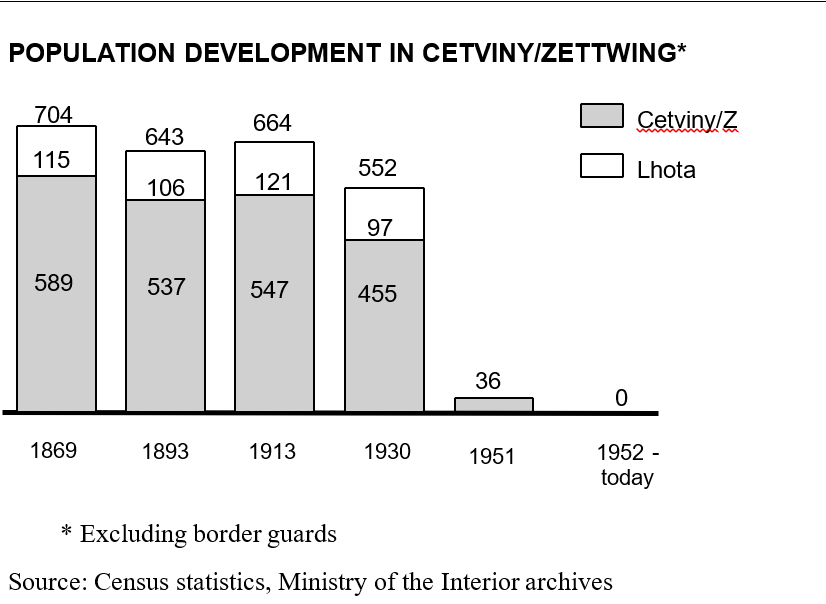
Cetviny/Zettwing probably reached its highest population in the 19th century, when statistics show more than 700 inhabitants. However, at the end of the 19th century and the beginning of the 20th century, the population declined slightly. The last pre-war census from 1930 recorded 552 inhabitants and 121 houses in Cetviny/Zettwing. Of these, 455 inhabitants lived directly in Cetviny/Zettwing, while the remaining inhabitants lived in the nearby settlement of Lhota (Neustift).
The following graph shows the development of the population in Cetviny/Zettwing in approximately twenty-year intervals. The population figures do not include members of the border guard. Their number was around 50 in the 1950s.
What did Cetviny/Zettwing look like?
The town lay north of the Malše border river. It could be divided into two parts. In the upper part, there was a spindle-shaped square consisting of about 25 houses. The church, which is still preserved today, stood in the lower part.
The lower part, located closer to the border and traditionally called Prägarten, consisted mainly of smaller houses.
What was the ethnic and religious composition of Cetviny/Zettwing?
Cetviny/Zettwing was predominantly populated by the Germans speaking residents. The 1930 census recorded 523 people of German nationality and 29 citizens of Czechoslovak nationality in Cetviny/Zettwing, including Lhota. All of the inhabitants of Cetviny/Zettwing were Roman Catholic.
What did the inhabitants of Cetviny/Zettwing do for a living?
The inhabitants of Cetviny/Zettwing mainly worked in agriculture and forestry. Some inhabitants of Cetviny/Zettwing were engaged in crafts and trade, while others traveled to other regions for work. In the absence of industry and relatively harsh conditions for agriculture, Cetviny/Zettwing was a well-functioning but not wealthy municipality.
The farmers of Cetviny/Zettwing raised cattle and other domestic animals. In May 1945, the census commissioner recorded the following numbers of domestic animals:
| Cattle | Pigs | Sheep | Horses | Goats | Chicken | Geese |
| 433 | 111 | 68 | 31 | 154 | 881 | 219 |
This overview shows, among other things, that there was, e.g., one cow and two chickens per inhabitant of Cetviny/Zettwing.
At around the same time, the census commissioner also filled out forms for farmland. A significant portion of the production from this land was apparently intended for the aforementioned domestic animals.
Composition of agricultural land in Cetviny/Zettwing
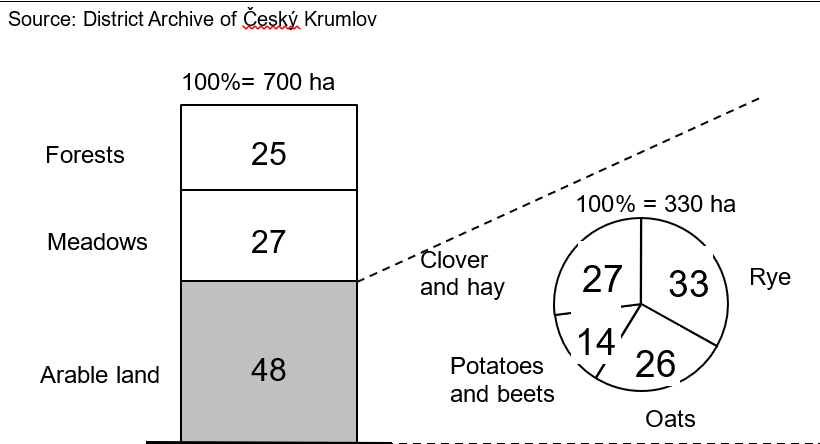
The graph shows that there were less than two hectares of land per capita, of which one hectare was arable. This land was mainly used to grow more resistant cereals - rye and oats.
In terms of crafts and trades, pre-war Cetviny/Zettwing had a dyer, cooper, hammer mill operator, clockmaker, grocer, barber, innkeeper, potter, tanner, hatter, baker, wheelwright, tailor, doctor, sign painter, miller, sawmill owner, brewery tenant, baker, insurance agent, general store and haberdashery, butcher, saddler, glazier, shingle maker, and carpenter (all these professions are listed on the information board for the “Crafts on the River” cycling route located in Cetviny/Zettwing).
How did the village develop in the post-war years?
In May 1945, Soviet troops arrived in Cetviny/Zettwing. Nothing prevented their entry, as active representatives of Nazi organizations had already fled.
In July 1945, members of the financial guard who had served there before the war began to return to Cetviny/Zettwing. Most of them were immediately appointed to the local administrative commission, which was in charge of running the village (after the war, Germans were deprived of their right to vote and were not allowed to elect their own representatives). Their main task was to organize the expulsion of the German population. In this difficult situation, the local people and members of the financial guard managed to maintain fair relations, and both sides contributed significantly to the fact that there was no violence or other illegalities in Cetviny/Zettwing, unlike in many other places in the republic.
Although the expulsion of the German population was decided relatively early on, the fate of Cetviny/Zettwing itself was not entirely clear for at least three years after the war. It took a long time to decide whether the village would be resettled. The Local Administrative Commission actively sought to resettle the village – correspondence with Volhynian Czechs, for example, is documented – but to no avail. The remote village (the nearest railway station was 15 km away) with harsh living conditions was not very attractive to immigrants. Thanks to this, Cetviny/Zettwing may have escaped the raids of gold diggers – according to eyewitnesses, only one such person came to Cetviny/Zettwing.
Over time, the village's chances of resettlement diminished. The first obstacle was the establishment of the Mountain Pastoral Cooperative, which in the summer of 1946 was entrusted with the use of all the land left behind by the displaced German population of Cetviny/Zettwing, Mikulov, and Tichá. This meant that there was no land left that could be allocated to potential settlers for farming.
The second obstacle was the political development in post-war Czechoslovakia towards confrontation with the Western world. This was also linked to the tightening of conditions in the border areas with Germany and Austria. Cetviny/Zettwing, located directly on the border with Austria, felt the consequences of these political developments immediately.
As a result of these circumstances, the village remained depopulated after the expulsion of the Germans. In mid-1948, there were about 60 Czech inhabitants living in the village, mainly families of civil servants (financial guards, SNB, teachers, postmaster) and a few German families who had not yet been expelled. In addition, three to five families of immigrants from other areas apparently settled in Cetviny/Zettwing. These were immigrants from Slovakia, Bulgaria, and Romania, employees of a pastoral cooperative. However, most of these immigrants (about a hundred) lived in Tichá.
The population of Cetviny/Zettwing continued to decline gradually over the next three years. Cetviny/Zettwing was finally evacuated in 1951 in connection with the creation of a border buffer zone to which civilians were denied access (according to border guard records, this involved eight families). In the meantime, the economy of the entire area changed. The pastoral cooperative lived up to its name and turned practically the entire agricultural area into pastures, mainly for sheep. A new sheepfold was built on the outskirts of Cetviny/Zettwing. The results were poor. A lack of workers and a lack of the necessary skills made a poor combination and, as a result, the cooperative was constantly making losses. From this perspective, it is conceivable that the decision to destroy the village was also seen as merely the closure of an unprofitable operation...
How and why was Cetviny/Zettwing destroyed?
The first steps towards its liquidation were taken immediately after the expulsion of the German population. The equipment of the farms was partly sold off and partly stolen, despite the efforts of the financial guard to maintain order. According to preserved records, the property was mainly stolen by employees of the pastoral cooperative, and eyewitnesses also mention the actions of one of the resettlers. Since even windows and doors were stolen, the unmaintained buildings quickly fell into disrepair.
In 1951, Cetviny/Zettwing was included in the so-called forbidden zone, and the only inhabitants of the abandoned village were members of the border guard. According to archival materials and published testimonies of eyewitnesses, the systematic liquidation of Cetviny/Zettwing took place from August 1955 to April 1956. The demolition was commissioned and financed by the Ministry of the Interior, represented by the Department of Internal Affairs of the District National Committee in Kaplice. The demolition itself was carried out by the company Zemstav n.p. (later reorganized into IPS, which was then acquired by Skanska a.s. during privatization) based in Prague, with the support of the border guard garrison in Cetviny/Zettwing. The farmsteads were gradually blown up and the terrain was then leveled with bulldozers. By Easter 1956, the destruction of Cetviny/Zettwing was complete and the remaining ruins were set on fire. The fire spread to the banks of the Malše River and threatened to cross over to the Austrian side.
The official reason for the destruction of Cetviny/Zettwing was apparently the same as for a number of other villages that suffered a similar fate. The communist regime claimed that abandoned buildings in the restricted zone could provide shelter and refuge for saboteurs, thus complicating border protection. The demolition of buildings in inhabited villages was justified on the grounds that dilapidated buildings spoil the appearance of the village and threaten the safety of its inhabitants.
Along with Cetviny/Zettwing, the villages that belonged to the parish of Cetviny/Zettwing were also destroyed: Mikulov (Böhmdorf), Janovu Ves (Johannesdorf), and Horní and Dolní Příbrání (Ober-/Untersinnetschlag). In total, homes for more than a thousand people were destroyed. Between 1955 and 1958, more than 600 houses were razed to the ground in the Kaplice district alone.
What was life like in Cetviny/Zettwing after its destruction?
A relatively strong border guard unit remained stationed in Cetviny/Zettwing to guard the restricted zone. This was the 9th Company of the 2nd Battalion, based in Kaplice. The entire battalion had about 200 soldiers and guarded about 60 km of the state border. Until at least 1958, the 9th Company was stationed in the former customs house right next to the state border, later moving further away from the border to barracks, the remains of which still stand today.
After the destruction of the village, the border guards serving in Cetviny/Zettwing were practically isolated, with the nearest inhabited place more than 10 km away. According to eyewitnesses, professional soldiers were often stationed in Cetviny/Zettwing as punishment. There were attempts to escape, but these were more frequent in the neighboring 8th company near the Dolní Dvořiště border crossing.